Adult Autism Testing
You’ve spent years figuring out how to fit in. Let’s understand what it takes to be you.
Explore autism, ADHD, and overlapping AuDHD patterns with Dr. Chad Calderon at Calderon Diagnostic Institute.
Virtual evaluations across California, Colorado, and North Dakota.
-
A clinical interview, developmental history, and standardized measures such as the SRS-2, CAT-Q, ABAS-3 and AQ-10 screener. When appropriate, the Adolescent/Adult Sensory Profile helps clarify how sound, light, touch, and other sensory experiences affect daily life. We also explore social communication, hidden coping efforts, and possible ADHD overlap. No single score determines your diagnosis.
-
Wondering why social situations, sensory demands, or changes take so much energy? An evaluation can help explore whether autism, ADHD, overlapping AuDHD, or another explanation fits your experience.
-
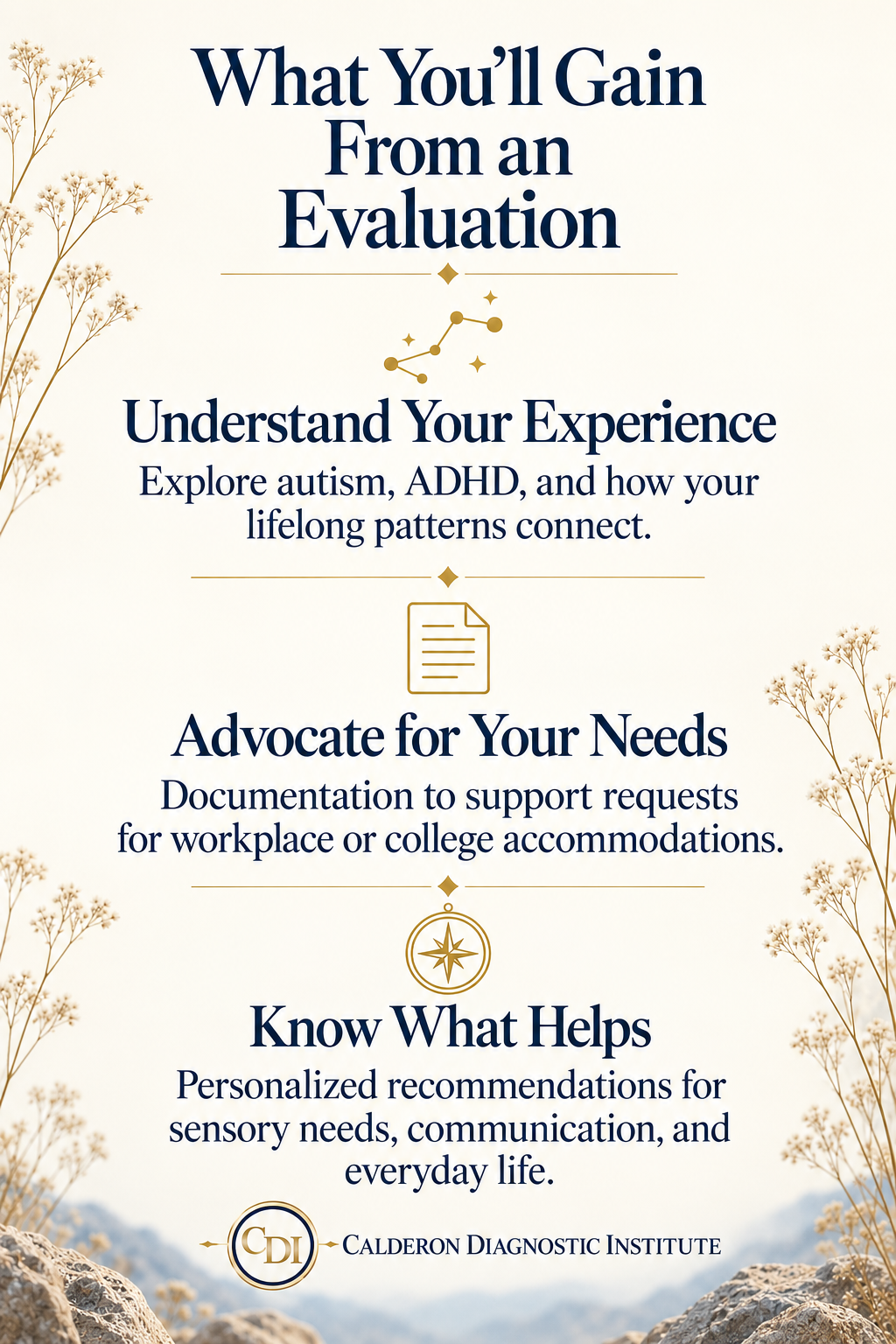
Get clarity and documentation to support requests for workplace or college accommodations, guide more personalized care, and explain your needs with confidence. Understanding your patterns can help you advocate for support that fits your life.
-
Adult autism evaluation: $1,000.
Combined ADHD and autism evaluation (often called AuDHD): $1,500–$2,000
Both options include assessment, personalized feedback, practical recommendations, and written documentation of your results. Start with a free 15-minute consultation to find the right fit.
Feel like you’re constantly translating rules everyone else seems to know automatically?
You’re not broken. And you’re not alone in wondering why these things keep happening.
Many adults come to us after years of anxiety treatment, an ADHD diagnosis, or endless self-help — still feeling like something important is missing. They describe:
Wanting real connection but finding small talk and unspoken rules exhausting
Looking “fine” on the outside while the effort of managing eye contact, expressions, and social expectations leaves them depleted
Sensory input (noise, lights, clothing, chewing) that drains them in ways others don’t notice
Deep interests and a strong need for predictability that others sometimes misread
A nervous system that stays activated long after the day is over
These experiences aren’t exclusive to autism. That’s exactly why a careful evaluation matters.
At Calderon Diagnostic Institute, we help adults finally make sense of the patterns that have followed them for years — including possible autism, ADHD overlap, or both. You’ll leave with clear answers, practical recommendations, and the documentation many people need for accommodations.
If you’ve been carrying the question for a long time, you don’t have to keep guessing.
In California, Colorado, or North Dakota? Start with a free 15-minute consultation with Dr. Calderon to explore whether an evaluation is right for you.
Sometimes you notice what happens, but not why.
You enjoyed seeing friends, yet feel wiped out afterward.
You suddenly need everyone to stop talking, even though nothing seems wrong.
A small change ruins your afternoon, or a simple task leaves you stuck.
You may not notice what has been building up until you’ve reached your limit.
These are the kinds of unexplained patterns an evaluation can help you understand…
The Experiences Almost No One Talks About
The cost of looking comfortable. You make eye contact, manage your expressions, and keep conversations going, even when it takes conscious effort. Afterward, you’re drained, irritable, or need everyone to leave you alone.
Conversations that won’t end in your head. You replay what happened, trying to understand someone’s tone, what they meant, or whether you said something wrong.
Unfairness you can’t just brush off. Double standards, broken rules, or people saying one thing and doing another can stay with you long after others move on.
Getting stuck, even when you care. One email takes an hour to get right. Other tasks pile up. Starting, switching, or stopping can feel harder than the task itself.
Sensory discomfort others don’t notice. A shirt seam, chewing sound, buzzing light, or food texture can demand so much attention that concentrating becomes difficult.
Feelings that take time to settle. Other people’s distress or conflict can overwhelm you. You may need silence and solitude before you can think clearly or reconnect.
Exhaustion that keeps coming back. You rest, try coping tools, and push yourself to return, but the demands of daily life leave you depleted again.
These experiences can have several explanations, including autism, ADHD, anxiety, or a combination. An evaluation helps connect the patterns across your life rather than treating each struggle as a separate problem.

Why doesn't CDI use the ADOS-2?
The ADOS-2 is a valuable autism assessment tool, but it has limitations, particularly when evaluating adults who have spent years developing sophisticated masking and compensatory strategies.
One important limitation is that the ADOS-2 captures a snapshot of behavior during a structured testing session. How someone presents during that appointment may not reflect their lifelong experiences, the effort required to navigate social situations, or the difficulties they encounter in everyday life.
At Calderon Diagnostic Institute, we use our own clinical observations alongside detailed developmental interviews, standardized assessments, and carefully targeted clinical questions. We look beyond what is immediately visible, exploring not only how someone behaves, but why, how they developed those patterns, and what those behaviors may be costing them.
Way too many clinicians including neuropsychologists rely far too heavily on the ADOS-2, making a serious mistake: a brief testing session may capture the most obvious signs of autism while missing highly intelligent, high-masking adults who have learned to hide their struggles, leaving far too many people undiagnosed, misunderstood, and without the help they desperately need.
Clinicians can unintentionally place more trust in a person's performance on a test than in the person's own life story. Perhaps because that's how they were trained, or because they place too much faith in a test labeled the “gold standard” without fully understanding the many different ways neurodivergence can present. Research has shown that the autism assessment process itself can be distressing and even traumatic for some adults (Curnow et al., 2023; Crane et al., 2018; Jones et al., 2014). At CDI, we will not reduce you to a single test performance or score—or subject you to assessment practices that adults have described in research as childish, patronizing, or distressing.
Crane et al. (2018): Adults described assessment materials as childish and patronizing.
Curnow et al. (2023): Discussed age-inappropriate testing and potentially traumatic assessment experiences.
SHAPE study (2020): Some adults described testing activities as childish or patronizing, and some reported feeling re-traumatized.
Our approach emphasizes the depth of clinical inquiry, thoughtful differential diagnosis, and understanding the whole person rather than relying on any single assessment instrument.
Supporting Research — Strongest Evidence First
ADOS-2 Diagnostic Accuracy: Systematic Review and Meta-Analysis (2026)
Examining the Diagnostic Validity of Autism Measures Among Adults (2019)
ADOS-2 Accuracy in Adults With Complex Psychiatric Conditions (2017)
Our philosophy: An effective autism evaluation should reveal more than what a person demonstrates during testing. It should help explain the patterns that have shaped their entire life.
Prefer to talk it through first? Text or Call Us →
(415) 255-5558
Or fill out the short form below.
Tell us what you’re looking for and what you’d like help clarifying.
Dr. Calderon will follow up with you personally to answer questions and see if an evaluation is a good fit.
Free 15-minute consultation. No pressure. No commitment.