
About the CDI Functional Translation Model™
The CDI Functional Translation Model™ was developed as a teaching framework for clinicians conducting diagnostic evaluations, disability assessments, fitness-for-duty examinations, accommodations evaluations, and other functional assessments in which translating symptoms into real-world impairment is essential.
Symptoms describe what a patient experiences internally. Clinical decisions, however, often depend on understanding how those symptoms manifest in observable behavior and interfere with everyday functioning. Too often, clinicians document symptoms and immediately conclude that impairment exists without clearly identifying the behavioral link between the two.
The CDI Functional Translation Model™ provides a structured method for bridging that gap. By helping clinicians translate symptoms into observable conditions before identifying functional impairment, the model strengthens clinical reasoning, improves documentation, enhances diagnostic clarity, and supports more defensible opinions regarding functional limitations.
Whether used in diagnostic assessment, treatment planning, disability evaluations, return-to-work decisions, or accommodations recommendations, the model encourages clinicians to ask better questions, document more meaningful examples, and communicate functional impact with greater precision.
Better translation leads to better assessment, better documentation, and better clinical decision-making.

Why We Created This Model
One of the most common documentation errors in clinical practice is jumping directly from a symptom to a functional impairment. In reality, symptoms rarely impair functioning on their own. They first translate into observable behaviors and patterns that we refer to as conditions. These conditions may then interfere with work, school, relationships, self-care, and daily life.
The CDI Functional Translation Model™ provides clinicians with a simple framework for identifying that missing link. By translating symptoms into observable conditions before determining functional impairment, clinicians can improve diagnostic clarity, strengthen documentation, and better communicate the real-world impact of mental health conditions.



Symptoms Live Inside. Functional Impairment Shows Up Outside.
Great clinical evaluations connect the two.
One of the most common errors in clinical documentation is jumping directly from a symptom to a functional impairment. That leap overlooks the critical middle step: how symptoms translate into observable conditions.
The CDI Functional Translation Model™ provides a practical framework for identifying that missing link. By translating symptoms into observable conditions before determining functional impairment, clinicians can develop more accurate case conceptualizations, stronger documentation, and clearer explanations of how psychiatric symptoms affect real-world functioning.
By focusing on what a patient actually does—or is unable to do—as a result of their symptoms, clinicians can better understand how mental health conditions interfere with work, school, relationships, self-care, and other major areas of daily functioning.
Understanding the Links
One of the most common errors in diagnostic and functional evaluations is jumping directly from a symptom to a functional impairment. That leaves out the critical middle link: the condition through which the symptom affects behavior.
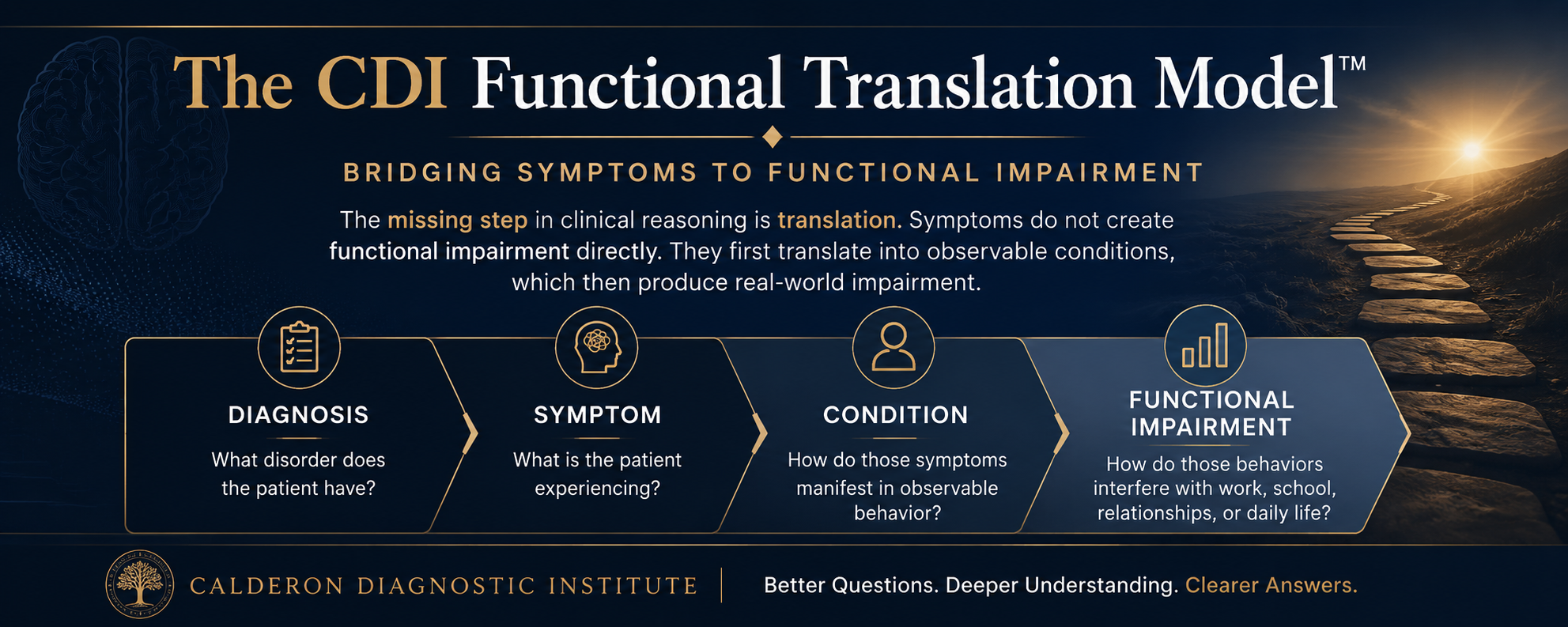
The Calderon Diagnostic Institute Functional Translation Model separates each step:
Diagnosis identifies the disorder.
Symptom describes the internal experience or clinical feature.
Condition identifies the behavioral or functional state through which symptoms affect performance. In other words, condition = what the symptoms cause the person to do, experience, or struggle with.
Functional Impairment describes the measurable consequence at work, school, in relationships, during self-care, or in other major areas of functioning.
━━━━━━━━━━━━━━━━━━
In simple terms:
What does the person have?
→ What are they experiencing?
→ What does that cause them to do or stop doing?
→ How does that interfere with their life?
━━━━━━━━━━━━━━━━━━
Think of it as a chain reaction:
Diagnosis identifies the disorder.
→ Symptoms describe what the person experiences.
→ Conditions describe what those symptoms cause the person to do (or stop doing).
→ Functional Impairment describes how those behaviors interfere with work, school, relationships, or everyday life.
Great clinicians don't skip the links.
━━━━━━━━━━━━━━━━━━
Example: Major Depressive Disorder
Diagnosis
Major Depressive Disorder
Symptoms
Anhedonia • Avolition (reduced motivation) • Anergia (low energy)
Condition
Behavioral inactivation: Remains in bed for several hours after waking despite intending to get up.
Functional Impairment
Frequently arrives late to work and receives disciplinary action.
This example also teaches another subtle point of your model: multiple symptoms can converge to produce a single observable condition, which then leads to measurable functional impairment. That's actually a more realistic representation of clinical reasoning than a one-symptom-to-one-behavior pathway.

Applying the Model
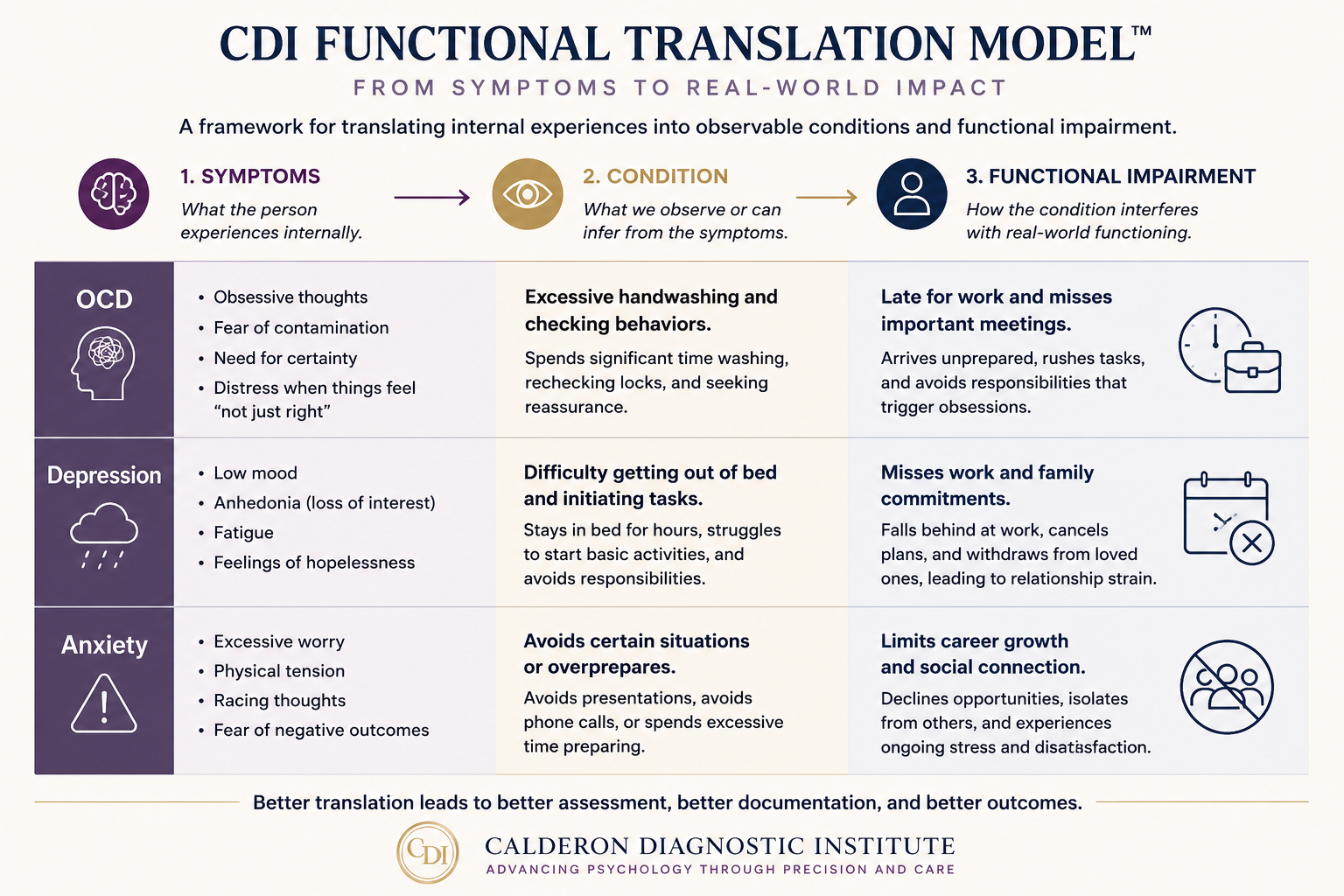
In each example below, the condition is shown in italics. It represents the observable behavioral or functional state that links a symptom to a real-world functional impairment.
Example: OCD
Contamination fear → Compulsive ritualization: prolonged handwashing → Frequently arrives late to work
Example: Anxiety
Excessive worry → Reassurance-seeking and overchecking: repeatedly rechecks emails → Frequently misses deadlines
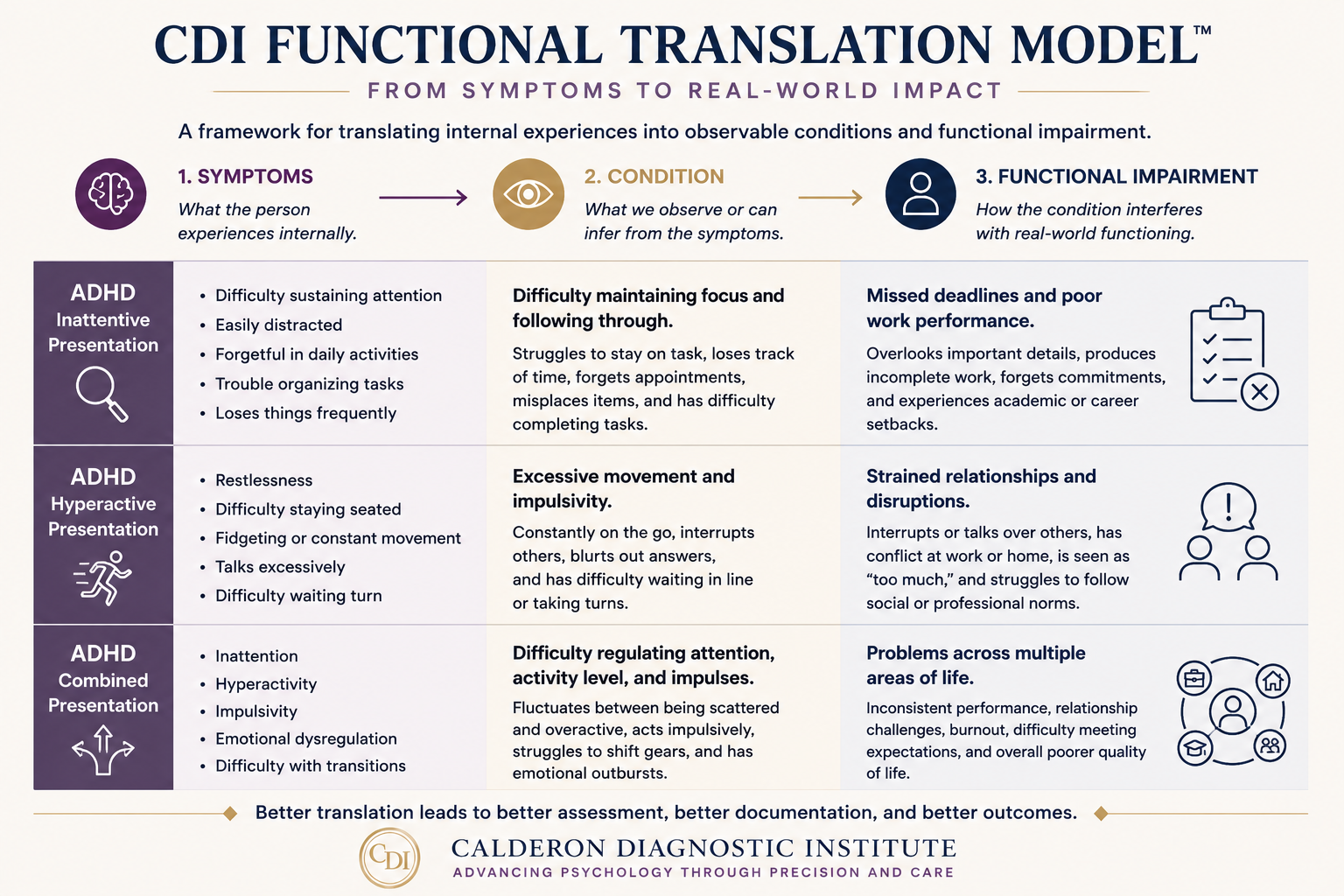
Example: ADHD
Distractibility → Task fragmentation: starts multiple tasks without finishing them → Frequently falls behind at work
Example: PTSD
Hypervigilance → Trauma-related avoidance: avoids crowded places → Avoids required work events
Example: Complex Trauma
Fear of rejection → Relational withdrawal: withdraws after conflict or criticism → Difficulty maintaining close relationships
Example: Borderline Personality Disorder
Abandonment sensitivity → Interpersonal dysregulation: repeatedly seeks reassurance after perceived rejection → Recurring interpersonal conflict