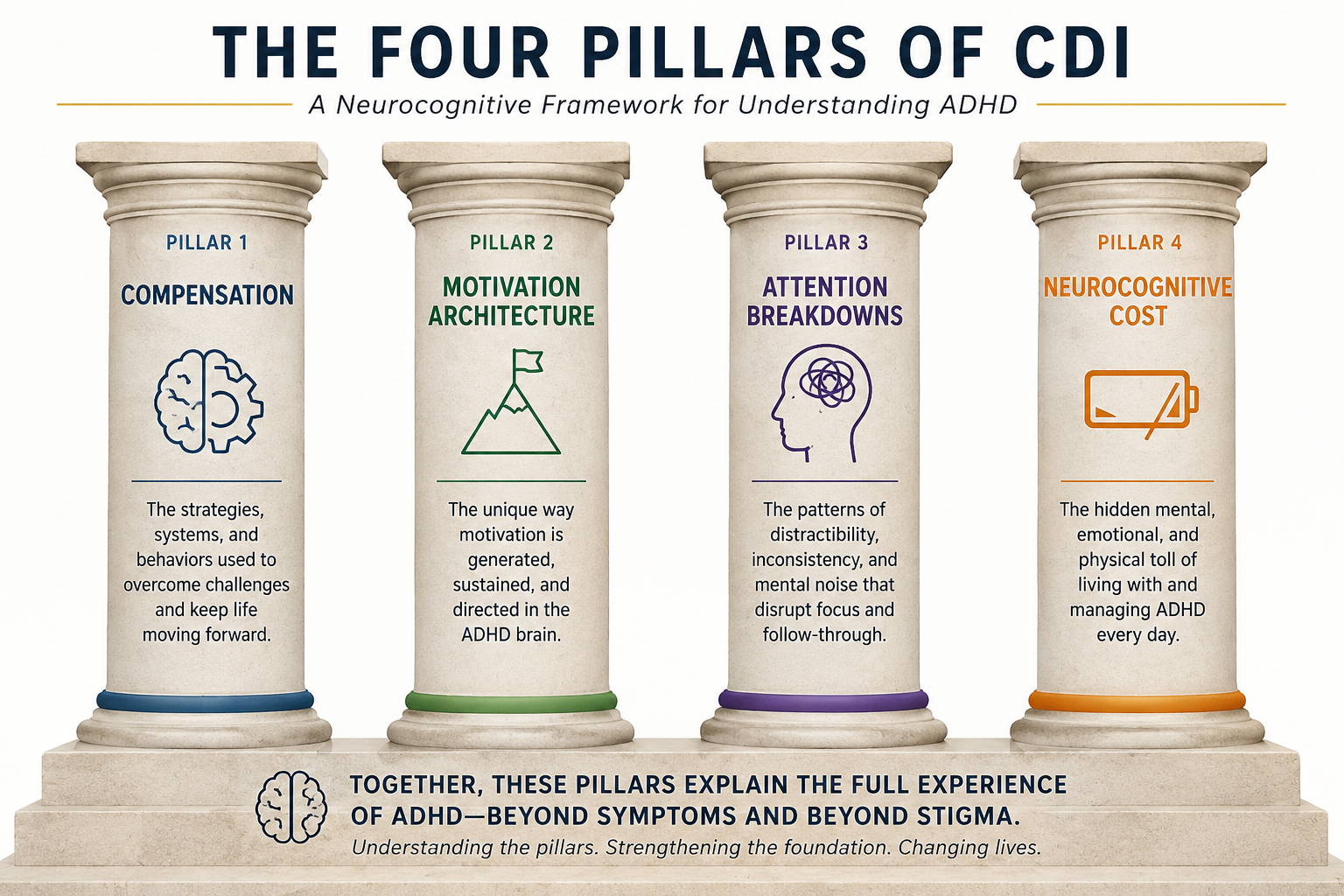
The Four Pillars of CDI provide a more complete framework for understanding ADHD beyond executive functioning deficits alone:
Compensation
Adaptive strategies that mask or offset underlying cognitive weaknesses to preserve outward performance
Motivation Architecture
The internal system of drives, rewards, and goal structures that determine whether effort is initiated and sustained
Attention Breakdowns
Sudden collapses in focus that produce task fragmentation, errors, or complete disengagement
Neurocognitive Cost
The elevated mental energy and resource expenditure required to complete tasks that feel effortless for others
“ADHD is not just a list of symptoms. It is a pattern of compensation, fragile motivation architecture, attention collapse, and hidden neurocognitive cost.”
-Dr. Chad Calderon

Clinical Psychologist · Author
ADHD · AuDHD · Personality Assessment · Psychopharmacology
Disability Evaluation · Peer Review · Clinical Training · Public Safety Consulting
Ready to get clear answers?
Click the button below to schedule your free 15-minute consultation.
Or call/text (415) 255-5558 — we’re happy to talk through whether this is the right fit for you.
An evaluation should explain more than a diagnosis
Many adults with ADHD learn to compensate so effectively that others see the achievement—but not the effort behind it.
You may be successful because you rely on urgency, perfectionism, anxiety, elaborate systems, excessive preparation, or hours of invisible recovery. Your accomplishments are real. So is the cost of maintaining them.
A comprehensive evaluation should consider not only what you achieve, but what it takes to achieve it. When that cost creates a substantial limitation in daily life, support or reasonable accommodations may be clinically appropriate.
Our goal is not simply to determine whether you meet diagnostic criteria. It is to help you understand why your mind works well in some conditions and struggles in others—and what can help it work better.
We look for the pattern beneath the symptoms
Difficulty focusing does not always mean ADHD. Similar concerns can arise from anxiety, depression, trauma, poor sleep, autistic overload, medication effects, substance use, or several interacting factors.
We examine when your difficulties began, where they appear, what improves or worsens them, and what else might explain them. This careful process—precision psychodiagnostics—helps us reach conclusions that reflect the whole person rather than a checklist.
We look beyond visible performance
Success does not rule out impairment.
Some adults perform exceptionally in demanding environments while struggling with basic tasks behind the scenes. Others function well when something is interesting, urgent, or highly structured but become completely stuck when those conditions disappear.
That inconsistency is not evidence that nothing is wrong. It is often one of the most important clues.
We assess both the difficulty and the system you built to work around it.
Context matters
Your mind does not function in a vacuum.
Interest, urgency, novelty, structure, sensory demands, emotional safety, sleep, and external support can dramatically change your ability to focus, organize, remember, and follow through.
Understanding these conditions helps explain why your abilities may feel available one day and unreachable the next.
Evidence guides us. Curiosity keeps us accurate.
Our evaluations bring together clinical interviews, developmental history, validated measures, behavioral observations, and collateral information when available.
Scores matter, but they are only one part of the picture. No questionnaire, computer task, or first impression can fully explain a person.
When the evidence is mixed, we will say so. When another explanation fits better, we will explain why.
Clarity should lead somewhere
A report should not leave you with a label and no direction.
You should leave with a clearer understanding of how your mind works and recommendations you can actually use. These may include treatment options to discuss with your medical provider, executive-function strategies, workplace or academic accommodations, therapy approaches, and practical changes to your environment.
What we will not do
We will not:
Reduce you to a test score
Label you as a generic “stress case” and send you on your way.
Assume achievement means you are not struggling
Dismiss difficulties because you learned to hide or compensate for them
Shame you for substance use or coping strategies
Bury the answer beneath clinical jargon
Give you a generic report that could describe anyone
The standard we hold
You should leave an evaluation with more than an answer to, “Do I have this?”
You should understand the pattern, the evidence behind it, the conditions that shape it, and what to do next.
“The purpose of diagnosis is not to place you in a box. It is to replace confusion with a more accurate understanding of yourself—and a clear path forward, without the clinical jargon or basic advice you have already heard a million times.”
Chad Calderon, PsyD, MSCP
Founder, Calderon Diagnostic Institute
When You Need Support, We Help Your Whole Care Team Move Forward.
CDI’s innovative Neurodevelopmental Diagnostic System was developed specifically for high-quality ADHD evaluations and forms the foundation of our precise, evidence-based approach to neurodevelopmental assessment that your care team will be able to understand and use. Many adults and youth have found clarity and effective treatment after completing a thorough evaluation.